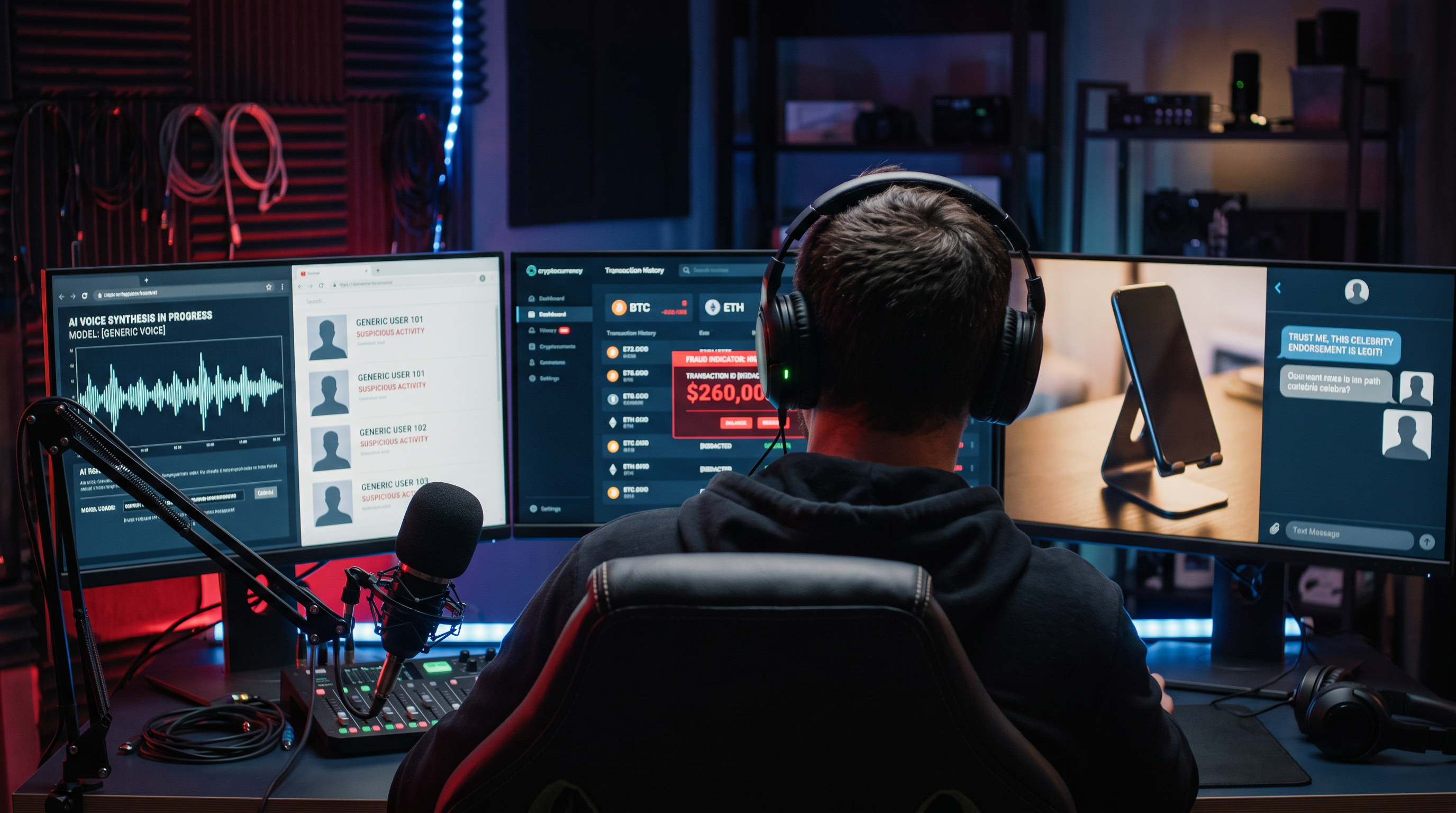
A fake celebrity endorsement that never existed has now put a Florida man behind bars. In what is being called the N3ON AI impersonation scam, prosecutors say David Anthony Sanchez used artificial intelligence to copy the voice of a popular streamer and talk cryptocurrency organizers out of about $260,000. He has been sentenced to 47 months in federal prison. The case is a blunt warning about how easily a cloned voice can beat the identity checks most people still trust.
Key facts
- The US Department of Justice announced on November 24, 2026 that David Anthony Sanchez, 36, of Port St. Lucie, Florida, was sentenced to 47 months in federal prison.
- According to federal prosecutors, Sanchez, also known as Dave the Jeweler, pleaded guilty to money laundering and aggravated identity theft.
- Prosecutors say Sanchez used AI to imitate the voice of streamer N3ON and convinced cryptocurrency memecoin organizers to transfer approximately $260,000 to accounts he controlled.
- N3ON was the impersonation target and not a participant in the scheme, according to the research behind the case coverage.
What Happened in the N3ON AI Impersonation Scam
According to the Department of Justice, Sanchez targeted the organizers of a cryptocurrency memecoin project. He allegedly convinced them that N3ON, a widely followed internet streamer, had agreed to endorse and promote their token.
No such agreement existed. The organizers believed they were dealing with the streamer and his representative, and they sent roughly $260,000 in cryptocurrency to accounts controlled by Sanchez, according to federal prosecutors.
It is worth being clear about who the victims were. N3ON did not take part in the scheme. He was the face the scammer borrowed, and the memecoin organizers were the people who lost money.
How the fake identities were built
Prosecutors say Sanchez created fraudulent social media accounts that resembled N3ON's legitimate profiles. He then posed as both the streamer and the streamer's representative, which gave the deal a believable two-sided feel.
To seal the pitch, Sanchez used artificial intelligence to imitate N3ON's voice, according to the DOJ. Hearing a familiar voice agree to a deal is the sort of proof many business contacts would accept without a second thought.
Why the endorsement pitch worked
Celebrity promotion is a major driver of attention in the memecoin world. A single post or video from a large streamer can move interest in a new token, so project teams are often eager to land a deal quickly.
That urgency is exactly what impersonators exploit. When a request looks like a rare opportunity, people tend to skip the slow steps that would expose a fake.
Sentence and Charges: 47 Months in Federal Prison
Sanchez pleaded guilty to money laundering and aggravated identity theft. The 47-month term is a settled legal outcome, not an unresolved accusation, which sets this story apart from many fraud headlines that stop at an arrest or indictment.
The DOJ's US Attorney's Office for the Southern District of Florida published the announcement, and the department updated it on November 25. You can read the original release on the Justice Department website.
Local outlet WPTV also covered the sentencing, describing it as a nearly four-year term in a $260K AI cryptocurrency fraud scheme. TheStreet, CBS12 and several crypto news sites ran the story as well.
What aggravated identity theft means here
Aggravated identity theft is a federal charge that applies when someone uses another person's identity while committing certain other crimes. In this case, prosecutors say the stolen identity was that of a real, recognizable streamer, used to make a fake endorsement look legitimate.
The money laundering charge relates to moving the cryptocurrency the organizers sent. Together, the two pleas capture both halves of the alleged scheme: the deception and the handling of the proceeds.
Why AI Voice Impersonation Scams Are So Hard to Catch
The core lesson of this case is that a voice is no longer proof of identity. Modern AI tools can imitate a person's speech from public recordings, and streamers publish hours of audio every week.
TheStreet's coverage of the case frames it as an example of how fake celebrity endorsement fuels investment scams. The same pattern applies well beyond crypto, from business payments to personal emergencies.
Traditional checks that no longer hold up
Several habits that once felt safe are now weak on their own:
- Trusting a familiar voice. AI can imitate tone and speech patterns convincingly enough to pass on a short call.
- Trusting a lookalike profile. Copycat accounts can mirror a real profile's name, photo and style.
- Trusting a representative. A scammer can play the manager as easily as the star.
- Trusting urgency. Pressure to pay quickly is a standard pressure tactic in almost every impersonation fraud.
How to Verify a Celebrity Endorsement Deal
If you run a crypto project, a small business or a creator brand, a few steps can stop a fake endorsement before money moves. None of them are complicated, but they do take discipline.
- Check the account itself. Look at the handle, creation date and follower history. Compare it with the verified profile linked from the person's official channels.
- Verify through a separate channel. Find the talent's management through an official website or a known business contact, not through the details the requester gave you.
- Ask for a live, unscripted interaction. A pre-agreed code phrase or a video call with specific questions is harder to fake than a short voice clip.
- Use written agreements. Legitimate endorsement deals involve contracts and clear terms, not just a chat and a wallet address.
- Slow down before sending crypto. Cryptocurrency transfers are typically difficult to reverse, so verify first and pay second.
Related AI Impersonation Cases
The N3ON case is part of a wider run of AI-assisted impersonation fraud. Our coverage of an AI impersonator targeting actor Ioan Gruffudd shows how the same tactic is used against public figures in other industries.
In the business world, prosecutors have also charged people in an AI CEO impersonation scheme, where a fake executive was the lure. And a separate report on an AI voice scam involving Raj Chakraborty illustrates how cloned voices are being used to push victims toward payments.
What to Do If You Were Targeted by an Impersonation Scam
If you believe you sent money to someone pretending to be a celebrity, influencer or their manager, act fast. Speed can matter when funds are moving through crypto accounts.
- Save every message, wallet address, transaction hash and screenshot.
- Report the case to the FTC at reportfraud.ftc.gov.
- File a complaint with the FBI's Internet Crime Complaint Center at ic3.gov.
- Report the fake accounts to the social platform where they appeared.
- Contact the exchange or service involved, since they may be able to flag the receiving accounts.
What the Sanchez Sentence Signals
The sentence shows that federal prosecutors are willing to pursue AI-enabled impersonation as a serious crime, and that courts are handing down real prison time for it. A 47-month term is not a symbolic penalty.
It also shows that the people most exposed are not always casual retail investors. In this case, the losses landed on project organizers who thought they were closing a promotional deal with a major streamer.
Comparative engagement figures for the story are not available, so its exact reach cannot be independently measured. What can be said is that it has drawn coverage from national finance sites and local Florida outlets alike.
Conclusion: Treat Every Celebrity Deal as Unverified Until Proven
The N3ON AI impersonation scam is a clear example of how a cloned voice, a few fake accounts and a convincing pitch can move six figures in cryptocurrency. According to federal prosecutors, Sanchez turned a streamer's public identity into a payment channel and now faces 47 months in prison.
The takeaway is practical. Never rely on a voice, a profile or a self-described representative alone, and always confirm through an independent, official channel before sending money. If you have seen a suspicious endorsement offer, report it to the FTC or the FBI, and share this article with anyone in your creator or crypto circle who handles promotional deals.
Frequently Asked Questions
Who is David Anthony Sanchez?
David Anthony Sanchez, 36, of Port St. Lucie, Florida, is also known as Dave the Jeweler. The Department of Justice says he pleaded guilty to money laundering and aggravated identity theft and was sentenced to 47 months in federal prison.
How did the N3ON AI impersonation scam work?
According to federal prosecutors, Sanchez created fake social media accounts resembling N3ON's real profiles and posed as both the streamer and his representative. He used AI to imitate N3ON's voice and convinced memecoin organizers that the streamer would endorse their project. They then sent about $260,000 in cryptocurrency to accounts he controlled.
Was N3ON involved in the scam?
No. N3ON was the target of the impersonation and was not a participant in the scheme. The victims who lost money were the organizers of the cryptocurrency memecoin project.
How can I tell if a celebrity endorsement offer is fake?
Verify the offer through a separate, official channel such as the celebrity's management website, not through contact details supplied by the person pitching you. Check the age and history of the social media account, ask for a live video call, and insist on a written contract. Be cautious of any deal that pushes you to send cryptocurrency quickly.
Where can I report an AI voice or impersonation scam?
In the United States, you can report it to the FTC at reportfraud.ftc.gov and to the FBI's Internet Crime Complaint Center at ic3.gov. Keep all messages, wallet addresses and transaction records to include with your report.