A growing wave of AI-generated deepfake advertisements is exploiting the faces, voices, and reputations of high-profile public figures, with entrepreneur Mark Cuban among those whose likeness has allegedly been used to push dubious health products to vulnerable audiences through paid social media promotions. The scam is not a fringe operation. Sophisticated actors are using synthetic video and voice-cloning tools to manufacture convincing celebrity endorsements, then buying promoted ad placements that bypass standard content moderation entirely. The result is a fast-moving, high-conversion fraud machine that is costing consumers money and eroding trust in digital platforms.
Key Facts
- Mark Cuban has publicly called out a major social media platform for running AI-generated paid ads using his image and voice to sell unverified health products to targeted audiences, according to reporting by the New York Post.
- Scammers purchase sponsored ad placements to distribute deepfake creatives, meaning the fake content reaches highly targeted demographics at scale rather than relying on organic spread.
- Newsweek has reported that celebrity deepfake scams involving figures such as Taylor Swift and Oprah Winfrey have resulted in documented financial losses for victims who believed the endorsements were real.
- Australia's financial regulator ASIC issued a formal warning in August 2026 about AI-powered impersonation scams using the likenesses of public figures to lure victims into fake investment and health product schemes.
- Cybersecurity firm Bitdefender has documented deepfake scams on TikTok using Taylor Swift's likeness, confirming the tactic is spreading across multiple major platforms simultaneously.
How the Mark Cuban Deepfake Ad Scam Works
The mechanics behind celebrity deepfake ad fraud are more structured than most people realize. It is not a matter of a single bad actor uploading a shaky video. According to researchers and investigative reporters, the operation typically follows a clear funnel designed to extract both money and personal data from victims.
First, scammers gather publicly available footage and audio of the target celebrity, in this case someone like Mark Cuban, who has decades of media appearances, interviews, and online videos to draw from. AI video synthesis tools then generate a short clip in which the celebrity appears to endorse a product, usually a health supplement, a medical device, or a financial opportunity. Voice-cloning software layers a synthetic audio track that closely matches the celebrity's real vocal patterns.
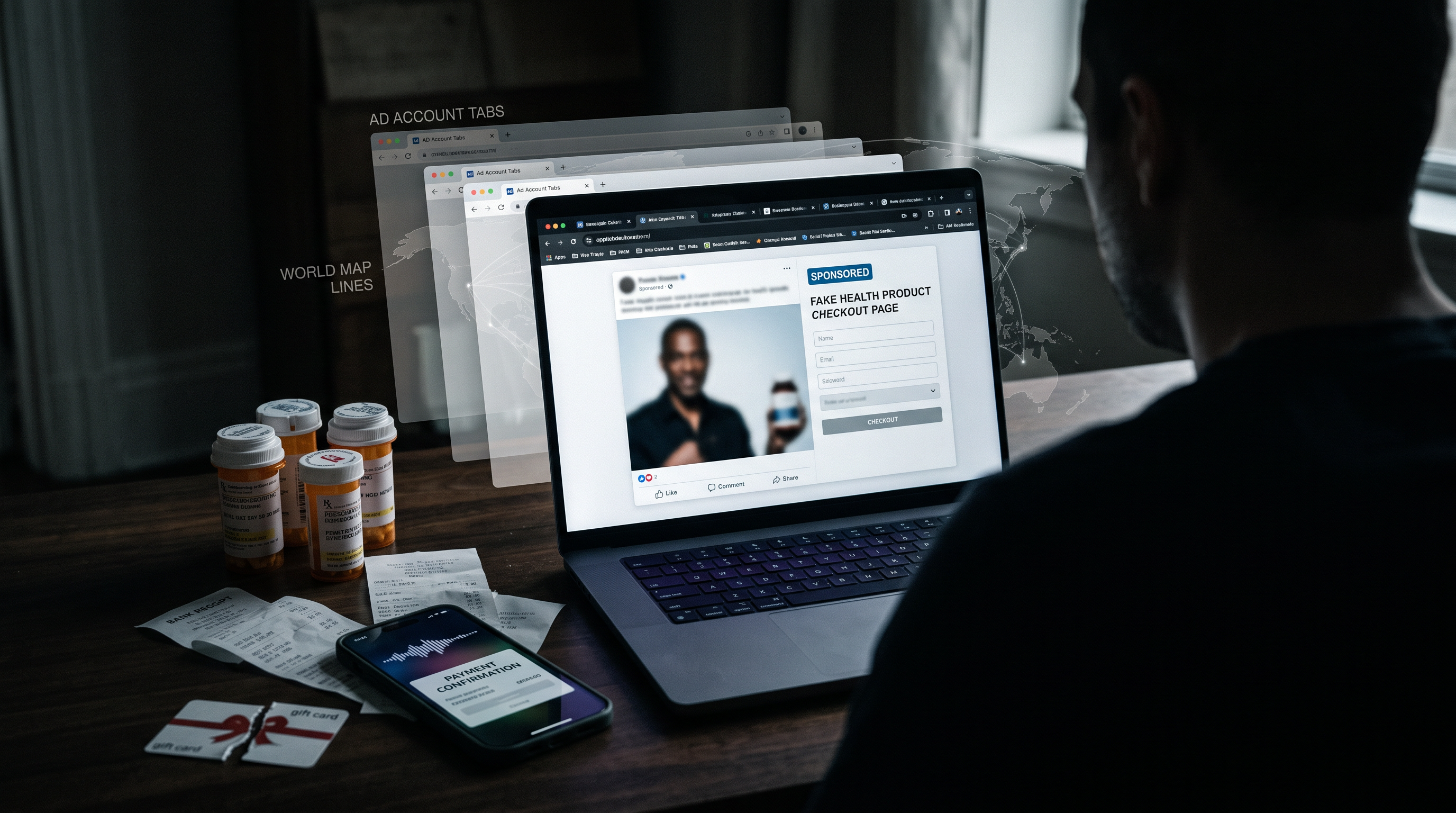
That synthetic video is packaged into a sponsored creative and uploaded to an ad account. The ad is then targeted at demographic groups most likely to trust the celebrity, often older adults or people searching for health solutions. Because the content enters the platform as a paid promotion, it skips the organic content review queues that might otherwise flag it.
The Funnel: Ad to Landing Page to Payment
Clicking the ad takes the victim to a fake landing page styled to look like a news article or an official brand website. These pages are designed to reinforce the illusion of legitimacy, often featuring fabricated testimonials, fake press logos, and countdown timers to create urgency. Victims are prompted to enter payment details and personal information to claim a discounted offer.
Payment processors used at this stage are frequently short-lived merchant accounts or third-party processors that are difficult to trace. By the time a victim disputes a charge, the landing page has often been taken down and the ad account suspended, with funds already moved through multiple layers. This type of operation closely mirrors the patterns documented in broader imposter scam reports tracked by the FTC, where fake celebrity and authority endorsements drive billions in annual losses.
Why Paid Ads Are the Scammer's Preferred Weapon
The choice to use paid promoted posts rather than organic content is strategic. Platforms invest heavily in systems to detect and remove fake organic content. Paid ad pipelines, however, are optimized for speed and volume, with less friction at the upload stage. An advertiser can create an account, upload a deepfake creative, set targeting parameters, and have an ad running to thousands of users within hours.
Platform ad libraries, which are public databases of active ads maintained by companies like Meta, have become a key tool for researchers trying to track these campaigns. Investigators recommend archiving ad creatives, capturing metadata from ad accounts, and using reverse image and audio search tools to identify duplicate creatives running across multiple accounts. The same synthetic video often resurfaces under different brand names and ad accounts after the original is taken down.
This is not a problem unique to one platform or one celebrity. Bitdefender has documented deepfake scams on TikTok using Taylor Swift's likeness, and Newsweek has reported similar campaigns targeting Oprah Winfrey. The pattern is consistent: choose a trusted public figure, generate synthetic content, buy ad space, and harvest payments. Similar tactics have been used in cases like the Al Roker deepfake scam promoting a fake health device, where the celebrity's trusted public image was weaponized to sell fraudulent products.
Regulatory and Platform Liability Questions
The Cuban case and others like it are forcing a direct question about who bears responsibility when a platform's ad system is used to defraud consumers. Platforms earn revenue from every ad impression, including fraudulent ones. Critics argue this creates a financial incentive to keep ad pipelines open with minimal friction, even if that friction could catch deepfake creatives before they run.
Australia's ASIC has already moved to issue formal warnings, according to ABC News reporting on the regulator's August 2026 advisory. That warning followed a wave of AI impersonation scams in the region, some involving finance journalists and public figures. The pattern in Australia mirrors what researchers are documenting globally. For related context, the Alan Kohler deepfake investment scam warned about by ASIC shows regulators are taking these cases seriously at the enforcement level.
In the United States, the FTC has authority over deceptive advertising practices, and consumer advocates are pushing for stronger identity verification requirements for advertisers, similar to know-your-customer rules applied in financial services. The argument is straightforward: if an ad account can be tied to a verified individual or business entity, accountability becomes easier to establish after a fraud occurs.
What Platforms Are Doing, and What Critics Say Is Not Enough
Major platforms have announced policies prohibiting synthetic media that deceives viewers, but enforcement relies heavily on automated detection and user reporting. Neither mechanism is fast enough to prevent harm when a deepfake ad reaches tens of thousands of users within its first few hours. Critics point to the Bank Leumi lawsuit against Meta over fake bank ads as evidence that platforms have known about advertiser verification failures for years without implementing adequate fixes.
How to Protect Yourself from Celebrity Deepfake Ad Fraud
Consumers can take concrete steps to avoid being victimized by this type of scam. Awareness is the first layer of defense.
- Verify any celebrity endorsement directly on the celebrity's official website or verified social media accounts before acting on it.
- Be especially skeptical of promoted or sponsored posts advertising health cures, supplements, or financial products, even if a familiar face appears in the video.
- Look closely at the video for subtle artifacts: unnatural blinking, lip-sync inconsistencies, or audio that does not quite match the mouth movements.
- Never enter payment details or personal information on a landing page reached through a social media ad for a health or investment product.
- Save any evidence, including screenshots of the ad, the ad account name, and the landing page URL, before reporting.
If you believe you have encountered a deepfake scam ad, report it directly to the platform using its ad reporting tools, and file a complaint with the FTC at reportfraud.ftc.gov. If you have lost money, you should also file a report with the FBI's Internet Crime Complaint Center at ic3.gov. Prompt reporting helps investigators identify patterns across multiple complaints and can assist in tracing payment flows.
Conclusion
The Mark Cuban deepfake ad scandal is a clear signal that AI-powered impersonation fraud has moved well beyond experimental attacks into a scalable, profitable criminal industry. Trusted faces are being cloned, bought advertising slots are being used as delivery vehicles, and vulnerable consumers are paying the price. Platforms, regulators, and consumers all have a role to play. Platforms must raise the bar for advertiser verification. Regulators must establish clearer liability frameworks. And consumers must treat every sponsored health or investment ad with skepticism, no matter whose face appears in it. Check official channels first, report what you see, and help others understand that a familiar face in a paid ad is no longer a reliable signal of trust.
Frequently Asked Questions
What is the Mark Cuban deepfake ad scam?
The Mark Cuban deepfake ad scam involves fraudsters using AI-generated video and voice-cloning technology to create fake advertisements featuring Cuban's likeness, which are then run as paid promotions on social media platforms to sell dubious health products. Victims who click on these ads are directed to fake landing pages where they are prompted to submit payment details and personal information. The scam exploits Cuban's trusted public profile to overcome buyer skepticism and increase conversion rates.
How do deepfake celebrity ads bypass platform moderation?
Deepfake celebrity ads are uploaded through paid advertising pipelines rather than posted as organic content, which means they move through a faster, lower-friction review process than regular posts. Platforms' content moderation systems are primarily built around detecting organic fake content, not sponsored creatives submitted through ad accounts. This allows fraudulent deepfake ads to go live and reach thousands of targeted users before detection and removal systems catch up.
Which celebrities have been targeted by deepfake ad scams?
Multiple high-profile figures have been targeted, including Mark Cuban, Taylor Swift, Oprah Winfrey, and Al Roker, among others. In Australia, finance journalists and public figures have also been impersonated in AI-generated investment scam ads. The selection of targets is deliberate: scammers choose individuals with high public trust and strong name recognition to maximize the credibility of the fake endorsement.
What should I do if I see a deepfake ad on social media?
Do not click on the ad or enter any personal or financial information. Use the platform's reporting tools to flag the ad as misleading or fraudulent, and capture a screenshot of the ad and the account name as evidence. You should also file a complaint with the FTC at reportfraud.ftc.gov and, if you have already lost money, submit a report to the FBI's Internet Crime Complaint Center at ic3.gov.
Are platforms legally responsible for running deepfake scam ads?
Platform liability for fraudulent ads is a contested and evolving legal area. While platforms generally rely on safe harbor protections for third-party content, consumer advocates and regulators are pushing for stronger advertiser verification requirements that could expand liability when platforms profit from fraudulent paid placements. Cases such as the Bank Leumi lawsuit against Meta suggest courts may be willing to examine whether platforms did enough to prevent known harms.